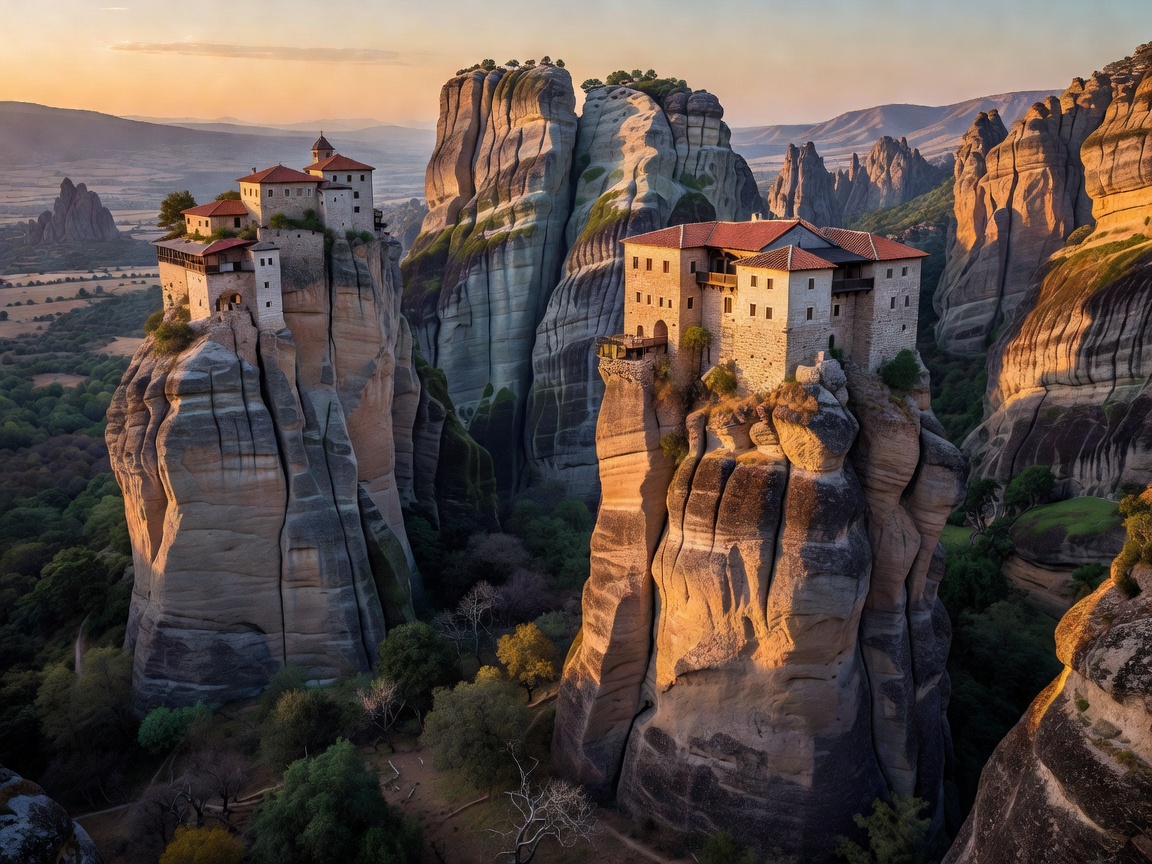
Located at the northern edge of the Plain of Thessaly, near the town of Kalabaka, the geologic complex of Meteora comprises nearly a hundred monolithic sandstone and conglomerate pillars rising up to 400 meters above the valley floor. Deposited approximately 60 million years ago during the Paleogene period by fluvial deltas, these rock towers were later shaped by tectonic faulting, weathering, and seismic activity into sheer vertical precipices.
Geographic Character of the Viewpoints
The panoramic interest of Meteora stems from the dramatic coexistence of raw geological spires with Eastern Orthodox Byzantine architecture. Beginning in the fourteenth century, hermits and monks constructed monasteries atop these isolated rock platforms. Today, six active monastic communities remain, crowning individual pinnacles and serving as focal points within the broad amphitheater.
The landscape is divided into two primary geological clusters: the eastern sector, dominated by the Holy Monastery of Saint Stephen and the Holy Trinity; and the western valley, anchored by Great Meteoron, Varlaam, and Roussanou. These sectors are connected by a winding, asphalted ridge road constructed in the mid-twentieth century, which provides multiple roadside observation ledges.
Psaropetra Observation Deck
The primary formal viewpoint in the complex, Psaropetra, sits on a rounded conglomerate outcrop directly adjacent to the road between Saint Barbara Roussanou and Holy Trinity. From this vantage, visitors can inspect four distinct monasteries simultaneously, with the snow-dusted Pindus mountain range providing a continuous background horizon to the west.
Key Observation Ledges Comparison
| Location | Altitude | Primary Sightlines | Safety Infrastructure |
|---|---|---|---|
| Psaropetra Promontory | 380m | Roussanou, Varlaam, Pindus Range | Partial low stone barrier |
| Sunset Rock (Metéora Viewpoint) | 395m | Western gorge, Great Meteoron | Natural bare rock ledge (No fence) |
| Varlaam East Shoulder | 370m | Great Meteoron exterior facade | Roadside gravel shoulder |
| Holy Trinity Approach Gap | 340m | Kalabaka town, isolated Trinity spire | Stone staircase parapets |
Seasonal Light and Microclimate Realities
Meteora experiences a continental microclimate markedly distinct from the coastal Greek islands. Winters bring dense valley fogs that fill the lower canyons, causing the monasteries and upper monoliths to protrude like islands in an ocean of mist. This inversion phenomenon creates exceptional photographic conditions during early mornings in November through March.
In midsummer, thermal heating off the Thessalian plains frequently generates late-afternoon localized convective clouds over the Pindus ridge. When the sun dips below these cloud bases approximately 40 minutes before official twilight, horizontal golden rays penetrate the gaps between sandstone towers, casting deep linear shadows across the monastic walls.
Visitor Safety and Conservation Etiquette
- Rock Surface Stability: The conglomerate stone consists of rounded river pebbles cemented in sandstone mortar. While extremely solid under foot, edge rims can suffer loose gravel scatter; close approach to unfenced vertical precipices poses severe fall risks.
- Religious Protocol: Several observation terraces sit immediately adjacent to active monastic enclosures. Visitors are expected to observe quiet zones and dress codes (covered shoulders and modest attire) if venturing onto monastic approach paths.
- Vehicle Parking: Road widths along the central scenic ridge are narrow. Parking must be restricted to designated paved turnouts to prevent blocking emergency access vehicles along the mountain corridor.