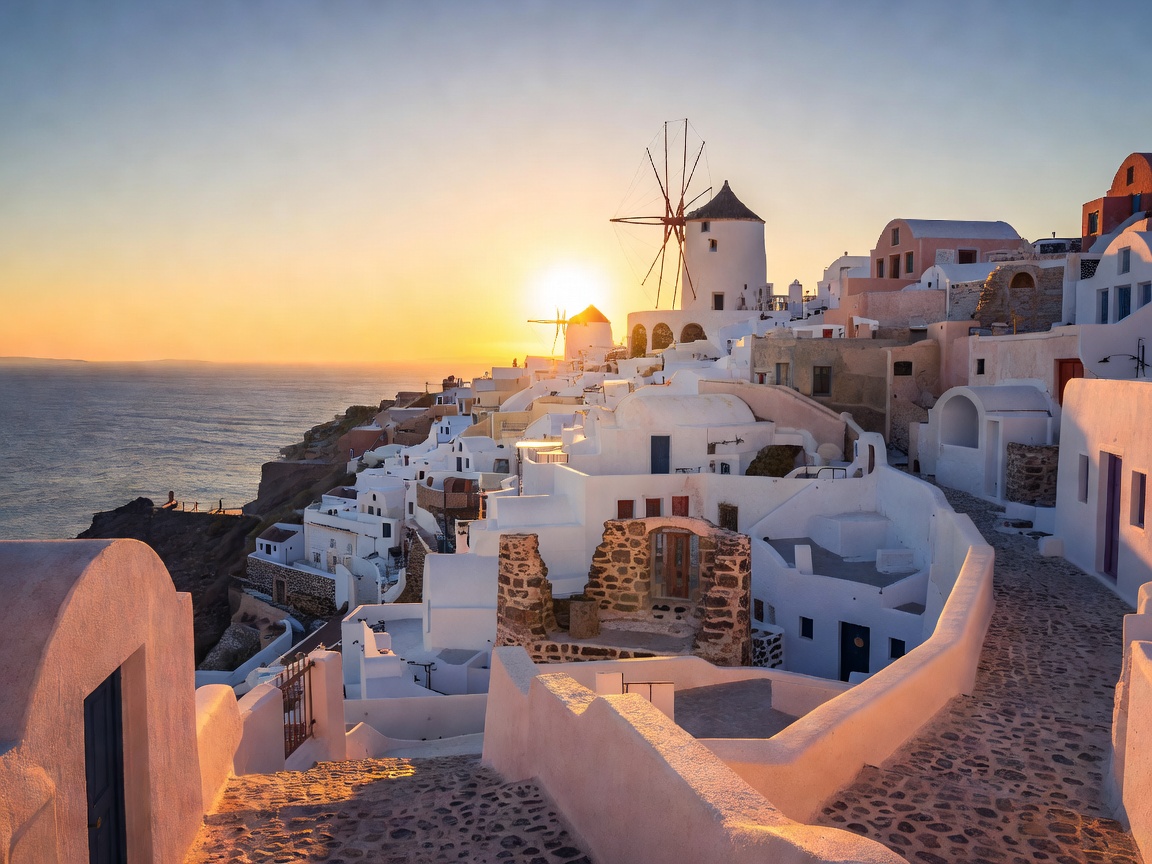
Perched on the extreme northwestern tip of Thira island, the remnants of the Byzantine Castle of Saint Nicholas (commonly known as the Kastro of Oia) constitute the most famous maritime sunset viewpoint in the Mediterranean. Erected during the fifteenth century under Venetian rule to monitor maritime passages against pirate raids, this fortified headland commands an unobstructed vista across the northern sea entrance of the caldera.
Topographical Setting and Architecture
The castle ruins sit approximately 120 meters above the maritime inlet of Ammoudi Bay. The promontory projects outward from the main settlement, creating a natural natural observation platform that provides views in two distinct directions: eastward across the terraced cliffside architecture of Oia—characterized by subterranean yposkafa (cave dwellings) and historic maritime captain mansions—and westward toward the open Aegean waters.
Because of this spatial geometry, viewers situated at the Kastro observe not merely the solar disk descending into the sea, but also the dynamic reflection of golden-hour illumination across the white lime plaster and pastel volcanic facades lining the cliffs behind them.
The Windmill Ridge Perspective
Immediately northeast of the castle ruins stand the traditional stone windmills of Oia. Looking back from the western battlements toward these windmills yields the classic postcard composition, capturing the full architectural cascade of northern Santorini without modern aerial obstructions.
Seasonal Solar Trajectory
The geographic azimuth of the setting sun varies significantly throughout the annual cycle, altering the visual composition from the Kastro:
| Season | Solar Azimuth | Drop Horizon | Architectural Lighting Effect |
|---|---|---|---|
| Summer Solstice (June) | ~300° (NW) | Open Aegean Sea | Direct side illumination on cave dwellings |
| Equinox (March / Sept) | ~270° (W) | Behind Thirassia Island | Thirassia silhouette with sea reflection |
| Winter Solstice (December) | ~240° (SW) | Central Caldera Basin | Direct frontal illumination across Fira cliffs |
Logistical Realities & Capacity Constraints
The castle footprint is physically restricted, consisting of crumbling stone wall segments and narrow paved terraces. During the high travel season (June through September), visitor density reaches peak saturation up to two hours prior to sunset.
The stone walkways leading down to the fortress are composed of smooth, polished marble flagstones. Decades of heavy foot traffic combined with sea-spray moisture create slick surface conditions, requiring caution when traversing the descending steps from the central church plaza (Panagia Platsani).
Alternative Vantage Options in the Northern Sector
- Ammoudi Bay Pier: Descending the 280 steps to sea level below the castle brings observers to water level, where the red volcanic conglomerate cliffs tower vertically overhead.
- Baxedes Ridge Road: For visitors seeking open horizons without pedestrian bottlenecks, the rural roadway leading eastward toward Baxedes beach provides distant perspectives back toward the illuminated village of Oia.
- Thirassia Ferry Channel: Maritime excursion craft positioned along the northern caldera gap offer eye-level views of the sun setting directly between the headlands of Oia and Thirassia.